
Sweeping for Mines
What my brother's 27-year minesweeper site taught me about building software that lasts


My brother Richard owns minesweeper.org. That's not "a" minesweeper site. It's the minesweeper.org.
If you own a domain like that, you've earned it. Here's how he did.
Richard created minesweeper.org in 1999 as a memorial to Princess Diana and her mission to ban landmines. The site featured an online game with daily leaderboards and even a site counter. And it was all free.
Richard wasn’t raising venture capital or planning an exit. He just wanted to do something that mattered.
The site ran for almost a decade, went dark for years when its technical foundation crumbled, and recently came back to life with new features. But through it all, it has never required an email address, never tracked user behavior (aside from the newer version saving high scores), and never charged a cent.
And somehow, in 2026, it’s still alive and well.
My brother did something subtly radical: he built software that serves people instead of extracting value from them.
And as a kid, I internalized that lesson.
The Origin: A Tragedy and a Mission
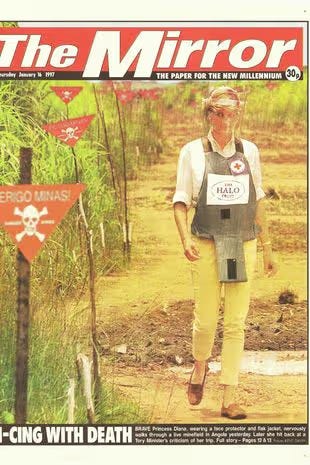
In August 1997, Princess Diana traveled to Angola to bring attention to the landmine crisis. At the time, Angola was reeling from a decades-long civil war that left an estimated 15 million landmines scattered across the country. These mines caused continuous civilian casualties, particularly among children. Princess Diana walked through cleared minefields in Angola wearing protective gear, and her presence forced the world to confront what landmines do: tear limbs from children, destroy families, and render land uninhabitable.
The world watched. The Mirror's front page screamed 'DANCING WITH DEATH' over an image of Diana walking through the cleared minefield in her protective gear. The coverage was impossible to ignore.
Richard saw those images.
Less than a month later, Diana was dead, but her campaign lived on. In December 1997, 122 countries signed the Ottawa Treaty banning anti-personnel landmines. Diana was posthumously credited with the Nobel Peace Prize awarded to the International Campaign to Ban Landmines.
My brother Richard was a graduate student at the time. He'd been following Diana's campaign and felt the weight of the dual tragedies: her death and the ongoing crisis she'd tried to solve. The United States, China, and Russia refused to sign the Ottawa Treaty. Millions of landmines remained buried in former conflict zones. People were still dying.
He wanted to help, but he was a programmer, not a diplomat. What could he do?
The answer was simple: he built a minesweeper game.
His logic was straightforward: minesweeper (the game) is about detecting and avoiding mines. Landmines (the real-world tragedy) kill and maim thousands of people every year. Why not connect them?
Richard created minesweeper.org with two goals:
Give people a free, well-designed place to play minesweeper online
Use that traffic to raise awareness (and money) for the HALO Trust, the organization that actually removes real landmines from real soil where real children play.

It was earnest, sincere, and utterly without irony.
And it worked!
The Golden Age: 1999-2007
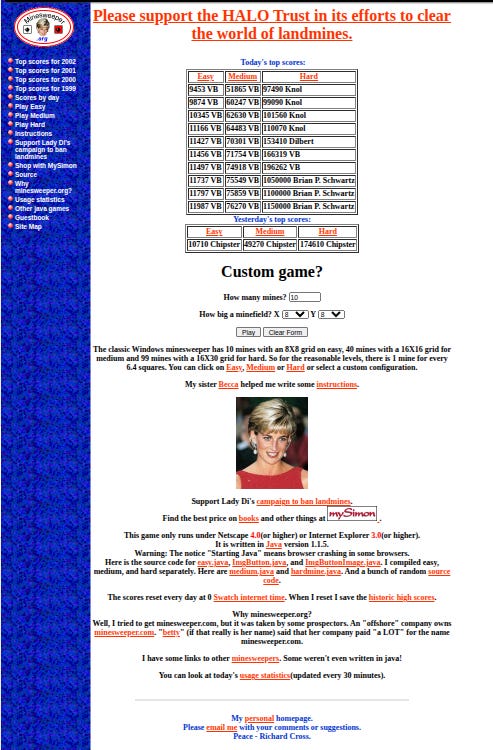
For about a decade, minesweeper.org quietly became the destination for serious minesweeper players. At its peak, people played about 1,000 games per day. A core group fought for leaderboard spots every single day. Carli dominated the Easy board. Magda would take Easy and Medium some days. Richard’s friends from grad school, Brian Schwartz and Leah De Wind-Bowen, owned the harder difficulties.
Player names weren’t filtered. When the scores reset at midnight, trolls would flood the boards. Dick Hertz was a frequent visitor, but the regulars would push him off within hours by posting better times.
The scores reset daily at midnight (Swatch Internet Time, because it was the late ‘90s and that seemed like a good idea). When Richard reset the leaderboard, he saved the historic high scores. You can still see some of the leaders from 2002.
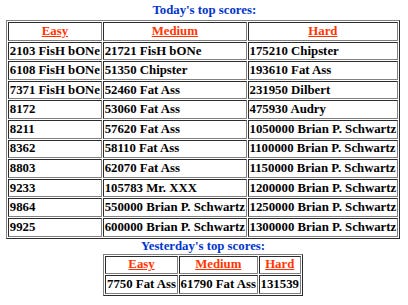
The site offered three difficulty levels: Easy, Medium, and Hard. Daily leaderboards tracked the fastest times. As a kid, I learned to play from his site.
The design was pure early-2000s web: a bright blue sidebar, simple HTML tables, and functional but unremarkable graphics. There were no JavaScript frameworks, no CSS animations. There was only clean, fast HTML that loaded instantly even on dialup.
It was truly a simpler time.
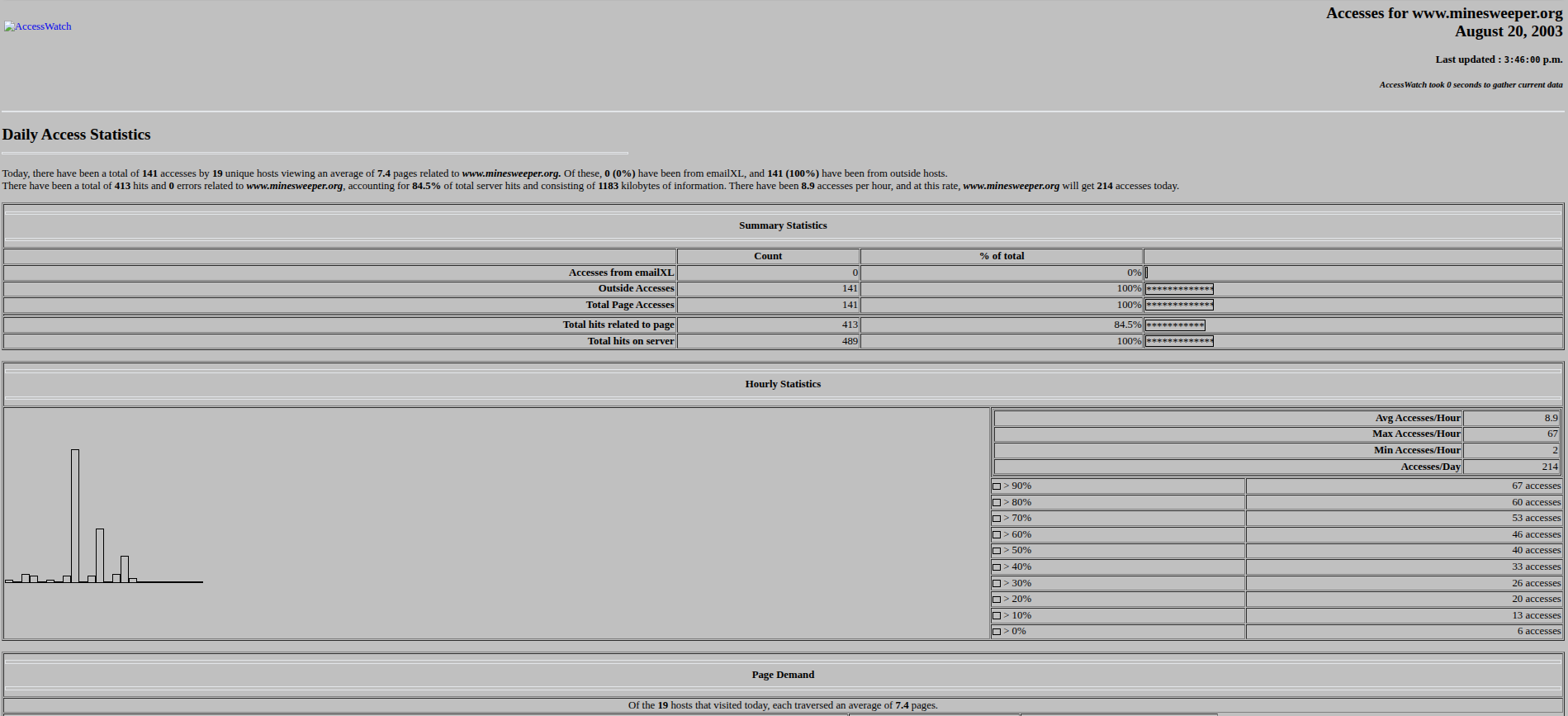
Richard ran the site alone. Our sister, Becca, helped write some of the instructions. He added features gradually: custom game configurations, multiple difficulty presets, source code availability for anyone who wanted to study or fork it. He even had a simple site counter to display traffic!
And crucially, he integrated the charity mission into everything. The site included affiliate links to Amazon and Powell's Books. If you bought a book through those links, Richard donated 100% of his commission to the HALO Trust.
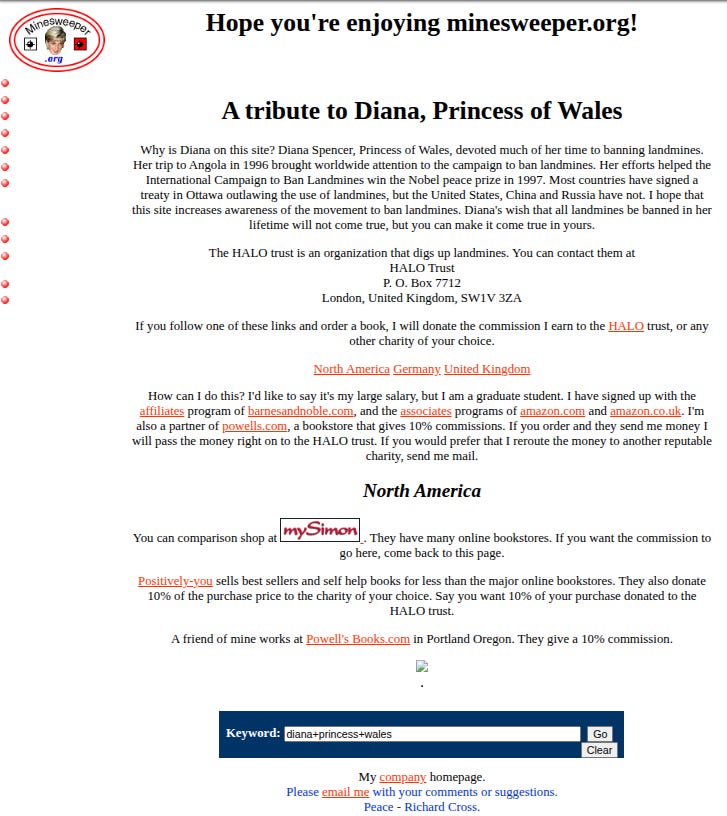
Hundreds of thousands of games were played. The daily leaderboards were consistently filled. The site never made money, but it raised awareness. And, occasionally, it raised actual donations.
The Collapse: When Your Foundation Crumbles
In October 2007 the site went offline.
Richard had no choice.
As you probably know, a lot has changed between internet in the 90s and now. One of those changes decimated minesweeper.org.
"I was using an application called FastCGI," Richard told me recently. "It had a security issue and the development team decided not to maintain it. I would have had to rewrite the entire site."
This is the nightmare scenario every developer faces eventually: the library you built on gets abandoned. The security patch never comes. Your choices are rewrite everything or shut down.
"It was a CGI exec library," Richard said. "I was devastated, but a rewrite would have been really hard."
So the site went dark. If you visited minesweeper.org, you'd find a placeholder page for Richard's hosting company. No explanation. No archive. Just... gone.
The leaderboards froze. The players scattered. A decade of work became inaccessible.
For a few months around the 2008 election, Richard briefly put up a message asking people to support Barack Obama's landmine policy instead. But mostly, the site just sat dormant.
The domain remained registered. The history remained preserved. But the game was unplayable.
This is technical debt in its purest form: the foundation rots, and you can either rebuild from scratch or walk away. Richard walked away. For twenty years.
The Long Silence: 2007-2020s
For years, minesweeper.org existed only as a memory.
Some players probably assumed Richard had lost interest. Maybe he'd sold the domain or just decided to move on to other projects.
The truth was simpler and more human: he just didn't have the time or energy to rebuild it.
Graduate school. Career. Life.
The site could wait.
The Revival: Starting Over
Fast forward to 2026. Richard decided to bring minesweeper.org back.
He’d wanted to rebuild for years, but the work seemed impossible. Then AI changed the math. What would have taken months became feasible with Claude Code.
Not only that, the mission was more relevant than ever. Russia had started using landmines in Ukraine. The Ottawa Treaty was signed by 160 countries in 1997, but the work wasn’t done. So Richard wanted to try something: could he and his two friends, Bill and Earl, build a modern gaming site using AI? Could they add features he’d been thinking about since the original site went down?
This time he built with modern tools: FastAPI for the backend, React for the mobile apps, MySQL for the database. They still have dependencies, but these are active communities with millions of users. The difference between FastCGI in 2007 and FastAPI in 2026? One was abandoned by its maintainers. The other has ongoing development and support.
The modern workflow is also more sophisticated than you’d expect for a free game. The team is three developers working in parallel with AI assistance, GitHub Actions for security checks, automated staging and deployment. Professional practices for a free game.
They’ve come a long way.
In 1999 it was early web development. In 2026 it’s AI-assisted collaboration.
The new version includes:
A board editor: Create custom minesweeper configurations
Tentaizu: A new puzzle variant that combines minesweeper logic with different rules
Modern browser compatibility: The original site ran on Java applets, which browsers eventually killed. The new version is pure JavaScript.
The same old leaderboards: Daily rankings still reset at midnight
The same mission: Support HALO Trust's landmine clearance efforts
The new version also handles trolls differently. You can sign in with Google to save your score. Or, you can play anonymously and your score gets purged. Richard can delete offensive names from an admin panel. The game stayed free but the trolls got filtered out.


The design remains deliberately simple. It's still the game and the mission. And on the About page, the same words Richard wrote in the 1990s are still there:
“Diana’s wish that all landmines be banned in her lifetime did not come true, but you can help make it come true in yours.”
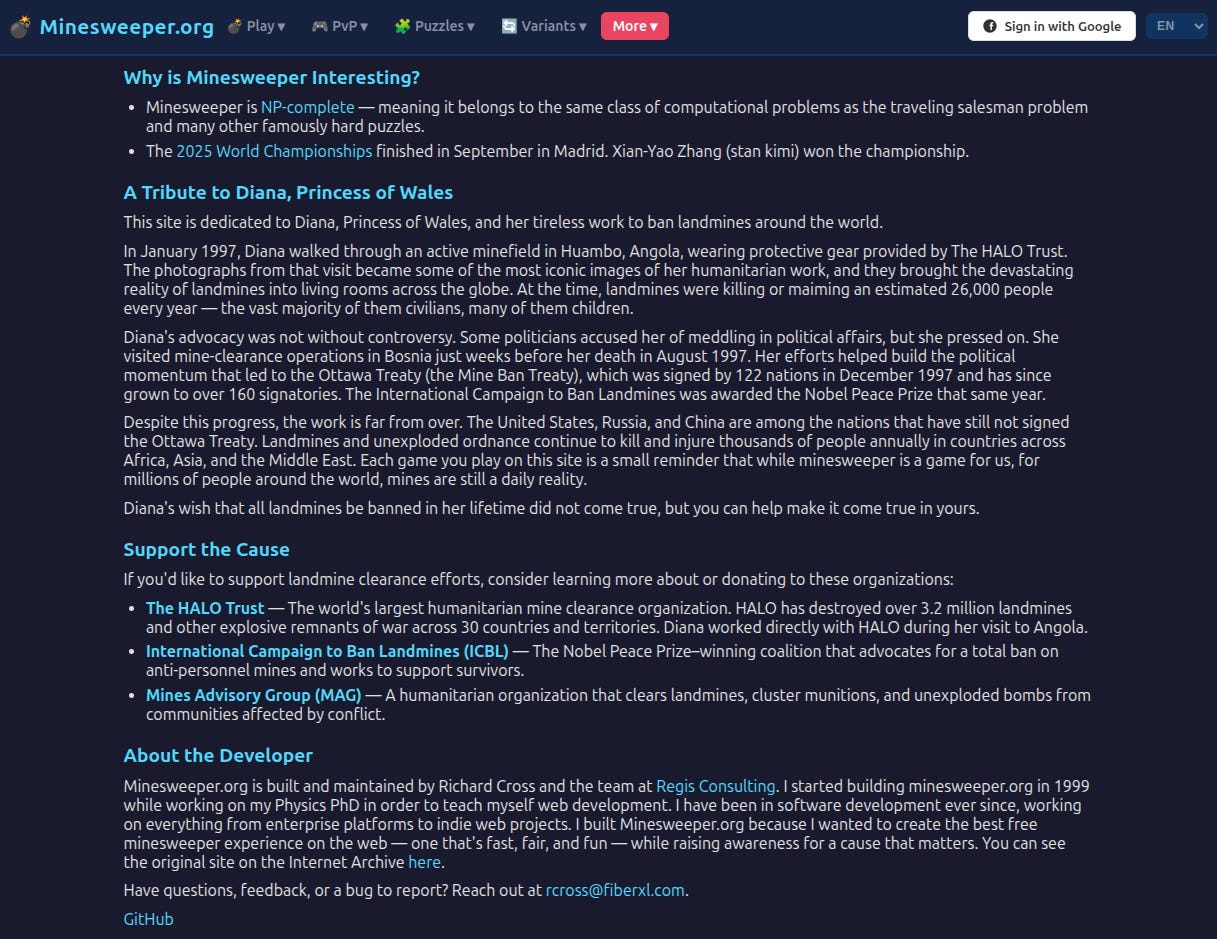
The revival worked. Within a month, the site hit 82,000 impressions per week. The old players came back. New players found it. Nearly three decades after its creation, minesweeper.org is more alive than it’s ever been.
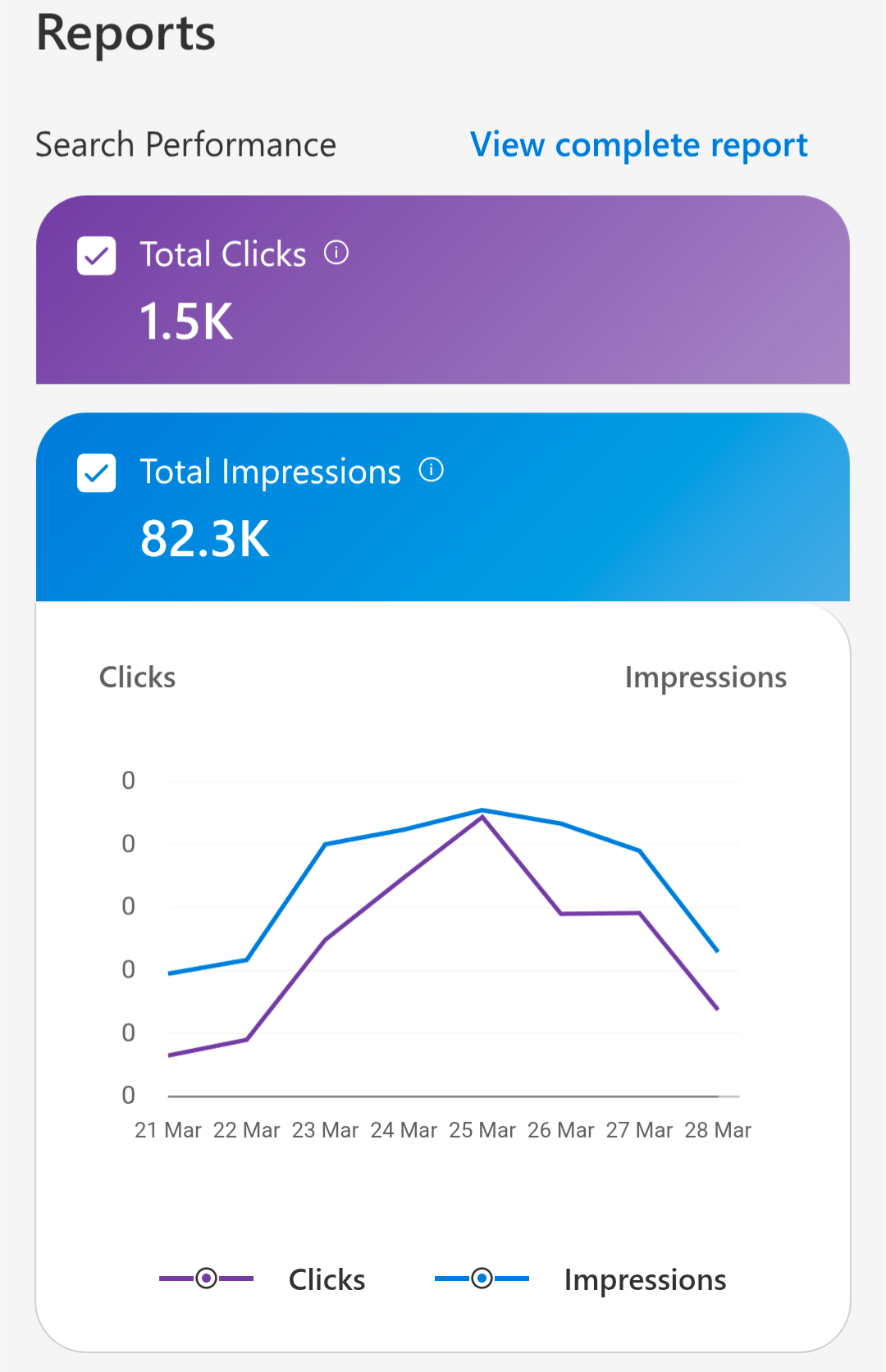
Richard didn't buy ads. He didn't post on social media. The site just... returned. And people came back.
What I Learned
I've spent the last decade building financial software at a major bank. I manage backend infrastructure for mobile SDKs that power credit applications. It's work I'm proud of, but it exists within the framework of ROI, quarterly metrics, and competitive advantage.
Before any of that, I was a kid. And my first experience with web development was watching Richard run minesweeper.org as a simple, free, fun place to play with purpose. Through its rise, fall, and resurrection, he taught me that there's another way to build software.
Lesson 1: Solve One Problem Really Well
Minesweeper.org doesn't have a vision to "disrupt the puzzle space" or "build a gaming platform." It plays minesweeper. That's it.
And that singular focus means it does that one thing exceptionally well.
Compare this to modern SaaS: feature bloat, pivot anxiety, "strategic roadmaps." Meanwhile, minesweeper.org still just... removes mines.
To this day my instinct is to make simple tools to solve singular problems. There's power in that kind of clarity.
Lesson 2: Don't Extract, Serve
Minesweeper.org has never required a signup, never pushed a subscription, and never harvested data. It's special.
Why? Because it serves people. That's the whole point.
This feels almost alien in 2026, where every interaction is a conversion opportunity, every user is a "lead," and retention metrics drive product decisions.
But here's the paradox: by NOT trying to monetize, the site earned something more valuable than money: trust and longevity.
When the site came back after years of darkness, the old players returned. They trusted that Richard built it for them, not from them.
Lesson 3: Choose Your Dependencies Wisely
FastCGI’s collapse taught a lesson: you can’t avoid dependencies, but you can choose wisely.
FastCGI was a single library with poor maintenance. The rebuild uses FastAPI, React, and MySQL. These aren’t obscure experiments. They’re proven tools with active communities.
When I build Restless Forge tools, I ask: Is this actively maintained? Does it have a community? Can I migrate if needed?
The specific technology matters less than the thinking. Am I building on something stable or something fragile?
Your foundation will eventually need replacement. Choose one that lasts twenty years, not five.
Lesson 4: The Mission Can Carry You Through the Dark
When Richard lost the site in 2007, he could have just... let it go. Moved on. Forgotten about it.
But the mission wouldn't let him.
Somewhere in the back of his mind, for all those years, was the idea that minesweeper.org should exist, that Princess Diana's campaign still mattered. The landmines are still there, and they still need to be swept.
The technical failure didn't kill the mission. It just delayed it.
This taught me that if you're building something with an actual mission (not just a business model dressed up as a mission) that purpose can sustain you even when the product fails.
The product is a tool. The purpose is the thing that lasts.
Lesson 5: You Can Always Start Over
The most important lesson: you can rebuild what you've lost.
It took years and required learning new technologies. The old code was gone forever. There was no git history to restore, no backup to resurrect.
But he did it anyway. From scratch. Because it mattered.
This is simultaneously terrifying and liberating.
Terrifying because all your work can vanish. Think about how much the internet has changed since 1999. How much do you think it will change in the next 30 years? You can do everything right and still lose it all.
Liberating because you can rebuild. Your knowledge remains. The mission persists. And the domain is still yours.
In a world where we're all building on rented platforms and borrowed infrastructure, that's a powerful reminder: the thing that lasts isn't the code. It's the commitment.
The Connection to Restless Forge
I didn't realize it at the time, but watching Richard run minesweeper.org was my education in what software could be. It could be more than a product to monetize or a platform to scale. It could be a tool that helps people.
That's what I'm trying to build at Restless Forge.
What Is My Time Worth isn't going to make me rich. It might not even make me anything period.
But if it helps 1,000 people make better decisions about their time, and if it's still helping people in 2030, 2035, 2040… Then I'll have built something that matters.
Same with HoloPath. It's a free tool that creates something beautiful. No signup. No tracking. No upsell funnels. No dependencies that could vanish.
Will these free tools make me financially independent? Probably not.
But minesweeper.org proved three things:
You can build something valuable without extracting value.
Simple architecture survives when complex systems die.
If the mission matters enough, you'll find a way to rebuild.
What Hasn't Changed
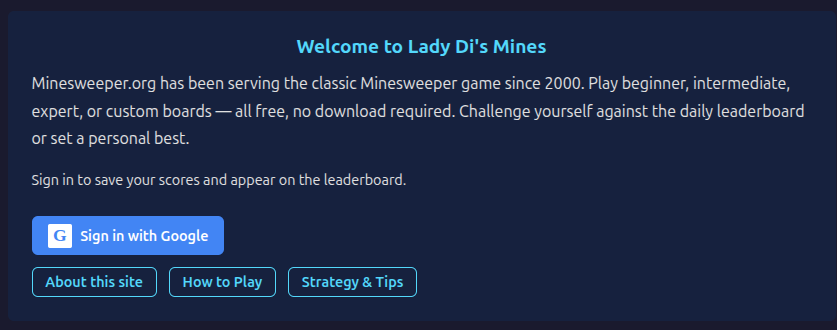
After twenty-seven years, multiple technical catastrophes, a complete rewrite, and a browser ecosystem that would be unrecognizable to the person who built the original, the core hasn’t changed.
It's still a mission-driven project, built by people who care about the cause, offered freely to anyone who wants to play.
No corporation owns it, no investors have a say in its direction, and nobody is running A/B tests on the donation button.
It's just Richard and his friends clearing mines—both digital and real—one game at a time.
Support the HALO Trust: halotrust.org
Check out Restless Forge: restless-forge.dev
If you found this valuable, I write about building software, making decisions, and creating things that last. And, of course, it'll always be free.
Historical image used under The Mirror’s terms for non-commercial, educational use.
Such a good reflection. I always learned stuff from my students, but this truly feels like coming full circle. Because of my relationship with you and your love for an idea I am learning from you. Thank you!
I’m so proud of you!