
What is My Time Worth?
I built a free tool to answer this question and tell you when to DIY vs hire

I’ve thought about this question habitually ever since high school economics taught me about opportunity costs. If you’re doing one thing, you’re not doing something else. And if you’re making $X per hour at your job, then any hour spent on something that pays less than $X is, mathematically, a losing trade.
This realization haunted me for years (and introduced significant anxiety into my teenage brain). Buckle up for some calculations and let me show you why.
The Penny Incident
Back in college, I had a habit of picking up loose change. Not compulsively, just whenever I saw a penny on the sidewalk, I’d grab it. Free money, right?
Then I did the math.

Each penny took me about 4 seconds to notice, bend down, and pocket. Let’s be generous and say 3 seconds on a good day. That’s 20 pennies per minute, or 1,200 pennies per hour. Multiply by $0.01... and I’m earning $12/hour. Minus the back pain.
But here’s what really got me: I drove to the bank to deposit my haul. Round trip: 45 minutes. Gas cost: maybe $2. My grand total for months of effort? $20.
Suddenly, those $0.01 pieces looked a lot different.
As a broke college student with a flexible schedule, I could rationalize it. Time had no real cost; I was procrastinating anyway. But the seed was planted.
Growing Up Changes Everything
Fast forward through undergrad, skip a decade forming a career, and press stop at 35. Suddenly time isn’t infinite. Weekends are precious. Every Saturday morning has at least four competing demands:
Put away the dishes (10 minutes, $0 earned, clean plates are obtained)
Fix the leaky garage door (2 hours, $0 earned, door is fixed)
Work on a side project (3 hours, potentially $50+ earned, or just pure learning)
Spend time with family
For the first time, I couldn’t do everything. And I started asking a dangerous question: Which of these is the actual waste?




If I’m making, say, $50/hour at my job, then mowing the lawn (3 hours) costs me $150 in foregone income, plus the emotional burden of a to-do list item. A professional lawn service charges $80. Suddenly paying someone $80 to save 3 hours and my sanity starts looking like the obvious choice.
But what if I’m not a high earner? What if mowing the lawn is relaxing? What if the garage door is more urgent than side projects?
That’s where it got complicated.
The YMOYL Moment
Then I read Your Money or Your Life by Vicki Robin and Joe Dominguez. Something clicked.
One central idea ties the book together: Money isn’t valuable in itself. Your life is.
They define a metric called “real hourly wage”. This is not your salary divided by hours worked. It’s your salary minus taxes, minus the costs of working (commute, clothes, decompression time), divided by your actual time spent in service of that income.
For many people, that number is half what they think it is.
“Money is your life energy converted into a medium of exchange” - YMOYL
If your real hourly wage is $28/hour, then:
Spending 2 hours researching a $15 savings at the grocery store costs you $56 in opportunity cost. You lost money.
Driving 30 minutes to save $20 on gas costs you $14 in time value. You broke even, minus the stress.
Hiring someone for $40/hour to do something that takes you 2 hours (and you hate) is saving you money, because those 2 hours are worth $56 to you.
The calculus flipped.
So I Built a Tool
I realized I was running these calculations in my head all. the. time. Morning to night:
Should I fix my own car? (Time: 4 hours at YouTube University. Cost: parts only, maybe $60. Mechanic: $120 + 1 hour of peace of mind.)
Should I meal prep on Sunday? (Time: 3 hours. Savings vs. takeout: $40/week = $2,080/year. If my time is worth $40/hour, that’s $120 in labor. Break-even at 3 weeks.)
Should I hire a contractor or DIY? (The classic. Contractor: $2,000 for 40 hours. DIY: 60 hours, steep learning curve, 3x the mistakes. Cost of my time: $1,200–$2,400, plus the mistakes.)
Every decision became: What is my time actually worth to me, right now?
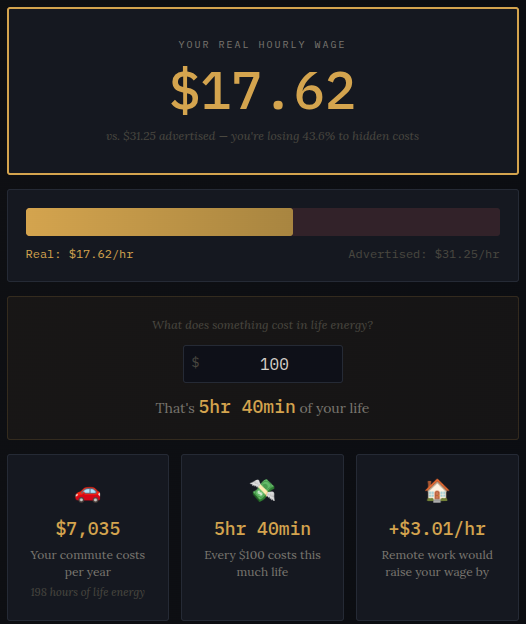
So I built What Is My Time Worth, a tool that does this math for you. It’s not complicated:
Enter your annual income (or target income, or freelance revenue)
Factor in taxes, health insurance, and retirement contributions
Add in the hidden costs of work: commute time, decompression, professional clothes
The tool calculates your real hourly wage
Then you use that number to make decisions
Is hiring a cleaner worth it? It’s worth $X/hour to you. If they charge $25/hour and your time is worth $32/hour, hiring them saves you money and time.
Is that side hustle worth your Saturday? If it pays $15/hour and your real wage is $40/hour, no. Unless you love it. I know, I know, it’s going to take off any day now.
Should you DIY the kitchen remodel? Uh, no. Only if you have unlimited time or you’re doing it for fun, not money.
The Actual Reality Check
Here’s where it gets awkward: most of us wildly overestimate our real hourly wage and wildly undervalue our time.
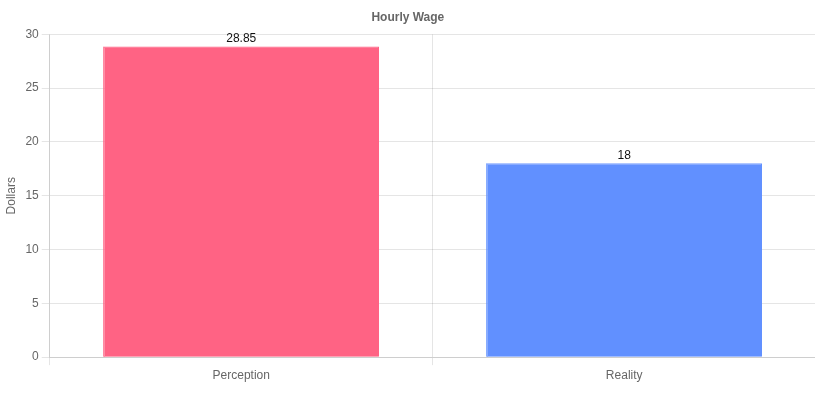
A salaried employee making $60k/year thinks they earn $28.85/hour (60,000 ÷ 2,080 hours). But after taxes (20%), health insurance ($300/month), commute costs ($150/month), work clothes, and the fact that you’re “at work” but not actually working 100% of those 8 hours?
That employee’s real hourly wage is closer to $18 (rounded to the nearest in the chart):
Conversely, we say “I don’t have time” for things that matter (family dinners, hobbies, rest) while spending 6 hours optimizing a decision that saves $12.
The Tool (No Signup, No Tracking)
This tool was built for 2026, which means:
It runs entirely in your browser
Your data never leaves your device
No signup, no email capture, no tracking cookies
Open source (if you want to audit the math)
It’s free because the original idea comes from a philosophy book, not a venture fund. I’m not trying to monetize your time anxiety.

The calculator has three parts:
What is your time worth? Honest assessment of your real hourly wage
Is it worth my time? Decision engine for individual choices (hire vs. DIY, buy vs. DIY, etc.)
Compare two jobs/offers Which actually pays more when you account for commute, hours, and quality of life?
What’s Missing?
I think this is a huge space to explore:
The psychology of why we DIY things that lose us money
How your real hourly wage changes life decisions (moving, changing jobs, having kids)
Geographic variations (is $40/hour in San Francisco the same as $40/hour in rural Ohio?)
The tax implications of side hustles and freelance income
But I’d genuinely love to hear from you: What would make this tool more useful? Are there decisions you run this calculation for that aren’t covered? Edge cases I’m missing?
Let me know!
Try the calculator here: What Is My Time Worth
You know what I had a similar thought and included a section at the bottom of the calculator for monthly obligations like rent and bills (and what's left is your discretionary spending fund). This gives you two numbers that you can use to make an informed decision.
Regarding savings say you should prioritize building retirement/cushion... It's more of a signal vs a ln adjustment to your actual wage. That could potentially be a flag in DIY vs hire (ie yes it's worth your time according to your wage but you should prioritize your savings first)
And I had a similar thought to your second point, too, where it assumes that all of your time could otherwise be spent earning that same wage, but hey my time at 3 AM probably couldn't otherwise be spent making big bucks
Really appreciate your feedback!!
What's the logic in excluding retirement savings/insurance?
The thing I have always found semi-problematic with calculating a personal hourly wage based off of income/time is the inherent difference in the marginal worth of each hour/dollar. The money you need for necessities is obviously worth a lot more than that same amount of money is for wants. Similarly the cost of your time is worth more the less you have of it available or based on the specific opportunity cost to do other things.